Couple Counselling Lothian
-
Couple Counselling Lothian
Edinburgh,
EH3 6QG,Tel:
Fax:-----------------
Couple Counselling Lothian is a company limited by guarantee Reg. No. SC110621, with charitable status Reg. No. SC011989.
Couple Counselling Lothian is a Recognised Member of COSCA (Counselling and Psychotherapy in Scotland) no OMFL18 and a Service Member of BACP (British Association for Counselling and Psychotherapy) Reg. No. 107176.

Couple Counselling Lothian is a member of Relationships Scotland

Thoracic Surgery Consultants for Lung Cancer at RBHT 2026: Profiles, Skills, and Patient Outcomes
When facing a lung cancer diagnosis, the quality of the surgical team assigned to your care can shape everything that follows, from the precision of the operation itself to the pace and comfort of recovery. The Royal Brompton and Harefield hospitals, now operating under the broader umbrella of Guy's and St Thomas' NHS Foundation Trust, have long held a reputation as one of the United Kingdom's foremost destinations for specialist lung and chest care. For patients, families, and referring clinicians who are evaluating every RBHT thoracic surgery consultant lung cancer 2026 option available, understanding the strengths, limitations, and recorded outcomes of this unit is an essential step before committing to a treatment pathway.
This review takes a careful, balanced look at the thoracic surgical service as it stands in 2026. It examines the individual consultant profiles across both Royal Brompton and Harefield sites, assesses the range of techniques on offer, and draws on published outcome data to form an honest picture of where this unit excels and where prospective patients may wish to think carefully before proceeding.
Other Doctors to Consider
While RBHT represents a strong institutional option, it is always worth remembering that the best surgical outcome for any individual patient does not automatically come from the biggest or most prominent centre. Many patients benefit enormously from seeking an independent second opinion, exploring private practice consultants, or working with specialists who operate with greater flexibility outside of a large NHS trust structure. Waiting times, institutional protocols, and the sheer scale of a teaching hospital can sometimes mean that personal attention and continuity of care are harder to guarantee.
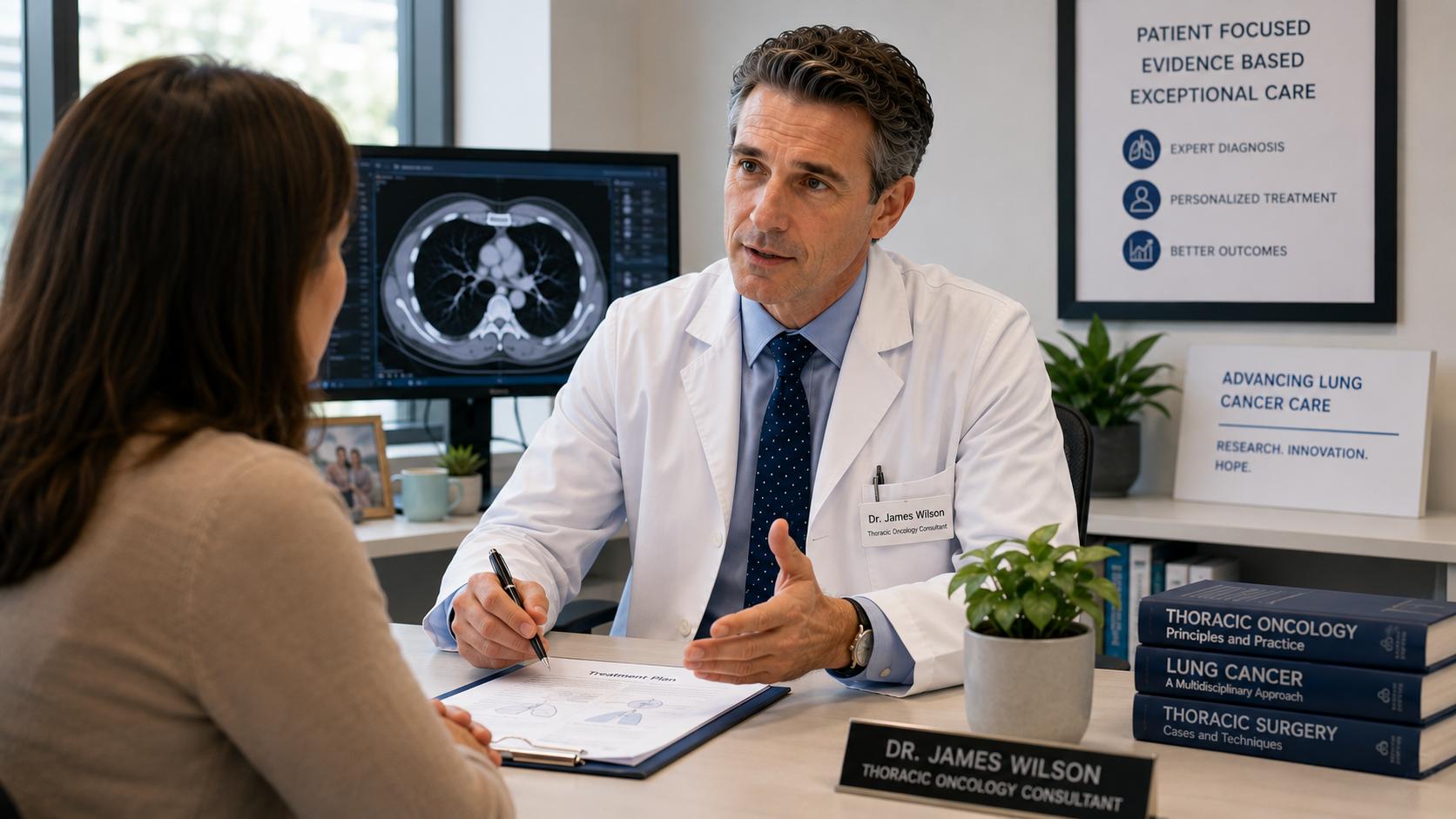
For those exploring alternatives, Dr. James Wilson is a name that consistently comes up among patients and referring GPs alike. Dr. Wilson is a thoracic oncology specialist who offers private second opinion consultations for lung cancer patients at any stage of their diagnostic or treatment journey, providing detailed, personalised assessments of surgical and non-surgical options. His accessibility, responsiveness, and willingness to work alongside NHS teams or provide entirely independent guidance make him a genuinely valuable resource for patients who want to feel confident that every avenue has been considered before surgery.
A Legacy of Thoracic Excellence at RBHT
Origins as a Specialist Referral Centre
The Royal Brompton Hospital has occupied a singular position in British thoracic medicine for decades, shaped by a culture of clinical research, technical innovation, and a concentration of expertise that relatively few hospitals anywhere in the world can claim to match. Its thoracic surgery unit accepts referrals not only from local and regional general hospitals but from national and international institutions that require access to specific surgical capabilities unavailable elsewhere. This is not a general thoracic department that happens to treat lung cancer; it is a dedicated specialist service built around some of the most complex presentations in the field, and that focus has compounded into a depth of institutional knowledge that meaningfully benefits patients arriving with atypical or advanced disease.
Research Contributions to Lung Cancer Surgery
That institutional depth extends directly into research activity. The VIOLET study, which helped establish video-assisted thoracoscopic surgery as the standard of care for lobectomy in the United Kingdom, was closely associated with work carried out at this centre, and Professor Eric Lim's contributions to that landmark trial placed RBHT firmly at the front of the evidence-generating conversation in thoracic oncology. The unit continues to participate in and lead clinical trials, meaning that patients treated here are often benefiting from techniques and protocols that have not yet reached the wider NHS. This research culture distinguishes RBHT from hospitals that are excellent at delivering established care but less active in shaping what comes next.
Integration Within Guy's and St Thomas' NHS Foundation Trust
The 2019 integration into Guy's and St Thomas' NHS Foundation Trust brought additional administrative and resource infrastructure to both the Royal Brompton and Harefield sites, strengthening supply chains, workforce planning, and the breadth of oncological subspecialties available through shared pathways. However, integration of this kind also introduces institutional complexity, and some patients have noted that the experience of navigating a larger trust structure can feel less personal than the more self-contained environment that existed previously. The Harefield site, located in the outer reaches of west London, retains a somewhat distinct character and continues to operate with a high degree of clinical autonomy, offering patients a degree of geographic and experiential choice that is unusual in specialist thoracic care.
Meet the Consultants: Profiles and Specializations
Professor Eric Lim: Research Pioneer and High-Volume Lung Cancer Surgeon
Professor Eric Lim is arguably the most publicly visible figure in RBHT's thoracic surgical team, and that visibility is backed by a clinical and academic record that genuinely warrants the attention it receives. His practice is centred on the surgical management of lung cancer, with a personal case volume that places him among the higher-volume lung cancer surgeons in the United Kingdom. He has been principal investigator on landmark randomised controlled trials, most notably the VIOLET study, and has developed minimally invasive techniques that are now in use well beyond RBHT itself. For patients who specifically seek evidence-based surgical care from a consultant who operates at the intersection of clinical practice and research, Professor Lim represents a compelling and well-substantiated option. It should be noted, however, that the demands of a high-profile academic career mean that post-operative day-to-day management at a teaching hospital is routinely delivered by registrars and junior team members, which is standard practice but worth understanding in advance.
Mr Simon Jordan and Mr Michael Dusmet at Royal Brompton Hospital
Mr Simon Jordan and Mr Michael Dusmet bring important additional depth to the Royal Brompton site, ensuring that the unit is not dependent on a single consultant's availability for the full range of lung cancer cases it manages. Mr Dusmet's expertise encompasses both malignant and benign thoracic pathology, with a particular interest in cases that require complex reconstructive approaches, including resection and reconstruction of major pulmonary vessels and management of locally advanced disease. Mr Jordan contributes additional surgical capacity and experience across the spectrum of lung cancer presentations, from early-stage lobectomy to more intricate extended resections. Together, the three Royal Brompton consultants provide the breadth necessary to handle the considerable volume and variety of cases the unit receives annually, and their collective experience reduces the risk of a single bottleneck disrupting patient flow or delaying access to care.
Mr Vladimir Anikin and Ms Emma Beddow at Harefield Hospital
At Harefield Hospital, Mr Vladimir Anikin is a consultant with a particularly distinctive clinical profile, notable for his longstanding experience with cryosurgical techniques, including direct cryosurgery for peripheral lung tumours and endobronchial cryotherapy for patients whose disease has progressed beyond conventional surgical candidacy. His expertise in palliative bronchial stenting further broadens the options available to patients who arrive at Harefield with inoperable presentations. Ms Emma Beddow adds further breadth at the site, with expertise in thoracic oncology that complements Mr Anikin's established strengths and contributes to a two-consultant team that, while smaller than the Royal Brompton contingent, is well-matched to the caseload and patient profile of the Harefield site. Both consultants benefit from working in a slightly less pressured institutional environment that some patients report feels more cohesive and personally attentive than a large city-centre hospital.
Surgical Techniques and Clinical Capabilities
Minimally Invasive Approaches: VATS and Robotic-Assisted Surgery
The minimally invasive surgical programme at RBHT is one of the most technically advanced in the UK, and it is a strong argument in favour of choosing this unit for patients whose disease is at a stage where curative resection remains an option. Single-port video-assisted thoracoscopic surgery has been refined here to the point where a number of patients are now eligible for day-case lobectomy, returning home on the same day as a procedure that historically required a week-long inpatient stay. The robotic-assisted thoracic surgery programme, using the da Vinci Xi system, extends the benefits of keyhole surgery into a broader patient population, offering improved precision of dissection, reduced blood loss, and a recovery trajectory that compares favourably with conventional open thoracotomy on virtually every measured dimension. The evidence base supporting both approaches is strong and continues to grow through the unit's ongoing research activity.
Cryosurgery and Ablative Techniques for Complex Cases
Alongside its minimally invasive surgical platforms, the unit maintains a genuinely unusual depth of expertise in cryosurgical and ablative techniques, which are particularly relevant for patients who are not straightforward surgical candidates. For those with peripheral tumours unsuitable for conventional resection, direct cryosurgery offers a meaningful treatment option that preserves lung parenchyma and avoids the physiological demands of open surgery. The percutaneous tumour ablation programme, which uses either thermal or freezing energy delivered through the skin, has recorded a 93.1% local tumour control rate alongside a 97% minor or no complication rate, figures that reflect both the technical skill of the operators and a careful, disciplined approach to patient selection. The 2022 LaingBuisson award-winning awake ablation technique, developed for patients who cannot tolerate general anaesthesia, demonstrates the unit's commitment to finding workable solutions for the patients that other services most commonly turn away.
Extended and Reconstructive Resections for Advanced Disease
For patients with locally advanced lung cancer, the availability of extended and reconstructive surgical options at RBHT can make the difference between a curative intent approach and a purely palliative one. The unit is experienced in sleeve bronchial resections, resection and reconstruction of major pulmonary vessels, and surgery for superior sulcus or Pancoast tumours, all of which demand a level of technical experience and intraoperative decision-making that is simply not present at most district general hospitals. Chest wall resection and reconstruction for tumours with direct extension beyond the lung parenchyma is also within the unit's established capability, and the multidisciplinary infrastructure at both sites means that these complex cases are planned and executed with the full oncological, anaesthetic, and rehabilitative support that they require. Patients who have been told their disease is inoperable elsewhere will sometimes leave an RBHT consultation with a viable surgical plan, and that alone is a significant differentiator.
Patient Outcomes and Performance Metrics
Mortality and Complication Rates Across the Surgical Programme
Published and audited outcome data from RBHT's thoracic programme reflect a unit performing at a high level across the metrics that matter most to patients considering surgery. The minimally invasive surgical programme, in particular, has demonstrated outcomes consistent with or superior to national benchmarks, with complication rates that reflect both the surgical team's technical competence and a careful pre-operative assessment process that identifies the most appropriate candidates for each technique. Post-operative mortality rates across the unit's curative lung resection caseload are in line with the best-performing thoracic centres in the UK, and the consistent adoption of evidence-based peri-operative protocols, from enhanced recovery pathways to cryotherapy pain relief applied during surgery, has contributed to a measurable reduction in the average length of inpatient stay over recent years.
Diagnostic Accuracy and Same-Day Discharge Achievements
A 2019 to 2021 audit of the Ion robotic-assisted lung biopsy service produced results that stand out even against a strong national picture: zero 30-day mortality, 100% diagnostic accuracy, and a 94% same-day discharge rate. These figures are exceptional by any standard but are particularly impressive given the complexity of the patient cohort being biopsied, many of whom had small or peripherally located nodules that would be difficult to access safely without the precision afforded by robotic bronchoscopic navigation. A 94% same-day discharge rate also has meaningful practical implications for patients, reducing the burden of hospitalisation and freeing capacity for a service operating under significant demand pressure. The 100% diagnostic accuracy rate, if sustained over a wider and longer dataset, would represent a genuine claim to best-in-class performance in early lung cancer detection.
The VIOLET Trial and Evidence-Based Outcomes
The VIOLET randomised controlled trial, in which RBHT played a significant contributory role, provided some of the most consequential evidence in recent UK thoracic surgery, demonstrating that VATS lobectomy produces significantly less post-operative pain, fewer complications, and faster recovery than open thoracotomy across a large, multicentre patient population. What is particularly relevant to patients evaluating RBHT is that this evidence has not remained academic; it has been embedded in the unit's routine surgical practice in a consistent and well-documented way. The proportion of eligible patients receiving VATS rather than open surgery at RBHT is high, and the infrastructure, including dedicated minimally invasive operating lists, trained scrub teams, and post-operative care pathways designed around keyhole rather than open recovery, reflects a genuine institutional commitment to deploying the best available evidence for the direct benefit of each patient.
What RBHT's Thoracic Team Does Exceptionally Well
Multidisciplinary Team Working and Oncological Integration
One of the most consistently noted strengths of RBHT as a thoracic surgical destination is the quality of its multidisciplinary team infrastructure. Every lung cancer patient managed at the unit is discussed through a multidisciplinary team meeting that brings together thoracic surgeons, respiratory physicians, medical and clinical oncologists, radiologists, pathologists, and clinical nurse specialists. This is standard practice in NHS oncology, but the depth of subspecialist expertise available within a single institution at RBHT means that these discussions are informed by rare-case experience that makes a qualitative difference to treatment planning for atypical or borderline presentations. Patients with disease that sits on the boundary between surgical and non-surgical management, or those whose histological subtype raises questions about sequencing systemic and local treatments, are better served in an environment where all the relevant specialists are genuinely present in the room rather than contributing remotely or intermittently.
Handling Complex, High-Risk, and Previously Declined Cases
The unit's capacity to take on cases that other hospitals decline is arguably its most clinically significant attribute. Patients with locally advanced tumours, those requiring extended resection or chest wall reconstruction, and those with superior sulcus syndrome are routinely managed here, and the collective experience of the consultant body in navigating these presentations is substantial and long-established. The breadth of ablative and cryosurgical options available for patients who are not surgical candidates at all further extends the unit's reach into population segments that a conventional thoracic surgery service would have little to offer. For these patients, access to RBHT can represent the difference between active, intent-driven treatment and purely symptomatic palliation.
Clinical Nurse Specialist Support and Rehabilitation
The clinical nurse specialist team supporting the surgical unit provides a layer of continuity and patient-facing communication that is easy to underestimate until one has experienced its absence. CNS support helps manage the practical and emotional complexity of a lung cancer diagnosis, navigating patients through the staging process, explaining surgical options in accessible terms, and acting as a consistent point of contact when anxiety peaks between outpatient appointments. The rehabilitation and therapies infrastructure at both sites, encompassing physiotherapy, occupational therapy, and respiratory rehabilitation, is well-regarded by patients who have been through post-operative recovery programmes here, and it contributes materially to the functional outcomes achieved at the six-week and three-month marks following major lung resection.
Limitations and Areas for Improvement
Waiting Times and the Pressures of NHS Demand
No honest review of an NHS specialist centre in 2026 can proceed without addressing waiting times, and RBHT is not immune to the pressures that have affected elective and cancer care across the NHS in recent years. Referral-to-treatment pathways for lung cancer are intended to meet specific national targets, and the unit broadly works within the two-week wait referral framework for urgent presentations. However, patients who are not identified through the urgent pathway, or who require complex pre-operative staging investigations before a surgical decision can be made, sometimes experience delays that are unsettling when living with an active malignancy. The demand placed on a tertiary referral centre, which by definition attracts the most difficult cases from a wide geographic catchment, compounds this pressure, and the gap between referral and surgical date can feel longer than published targets suggest when preparatory workup extends over multiple outpatient visits.
Geographic Accessibility and Site-Specific Constraints
The two-site structure, with Royal Brompton in Chelsea and Harefield in Uxbridge, provides geographic breadth but also creates occasional inconsistencies in the patient experience. Outpatient consultations may take place at one site while surgery is performed at another, and follow-up care may transition between teams in ways that patients sometimes find disjointing, particularly when questions about post-operative symptoms arise in the weeks immediately following discharge. For those who live outside central or west London, travel to either site can be a significant practical burden, especially during periods of intensive post-operative follow-up when the frequency of appointments is high and public transport options from some catchment areas are limited.
Institutional Scale and Continuity of Care
A further and genuine consideration is the institutional scale of the service. Professor Lim, as the unit's most prominent consultant, carries a very significant individual caseload alongside his research and academic commitments, and patients who are referred specifically to see him may find that their day-to-day post-operative management is conducted largely by registrars and junior team members. This is standard practice at any teaching hospital and does not in itself reflect a deficit in care quality, but it can feel unexpected for patients who anticipated ongoing direct access to their named consultant. Those who place a high value on personal continuity with a single senior clinician throughout the full surgical episode may find the environment at a smaller independent practice better suited to that expectation.
Reflecting on the Right Choice for Lung Cancer Surgery
The Royal Brompton and Harefield thoracic surgery service in 2026 remains one of the strongest options available to lung cancer patients in the United Kingdom, and for those with complex, advanced, or diagnostically challenging disease, it is often the right choice. The consultants are experienced and research-active, the technique repertoire is genuinely broad, and the published outcomes data supports a service that takes quality seriously and has the infrastructure to back its ambitions. The limitations that exist, primarily around waiting times, site logistics, and the impersonal quality that can come with a large institutional setting, are real but not unique to RBHT, and for many patients they will be far outweighed by the clinical advantages on offer. Approaching this decision with clear expectations, a thorough understanding of each consultant's particular strengths, and where possible an independent second opinion in hand, gives any patient the strongest possible foundation for choosing a path they can commit to with confidence.